
National parks fulfill a function that goes beyond tourism: they protect complete ecosystems and preserve landscapes that would otherwise be exposed to human exploitation.
From deserts with multicolored dunes to jungles crossed by striking waterfalls, these territories protect geological and biological processes that took thousands or millions of years to form. The variety of climates and reliefs that exist on the planet allows each continent to provide unique examples of this kind of conservation.
The specialized magazine Condé Nast Traveller published a ranking of the national parks considered among the most beautiful on the planet. Among the selected destinations is the Iguazú National Park, which is home to the Iguazú Falls – one of the New 7 Wonders of Nature in the world – located in the Argentine province of Misiones, along with protected areas that combine landscape value with concrete possibilities of exploration, from multi-day hikes to boats that approach waterfalls.
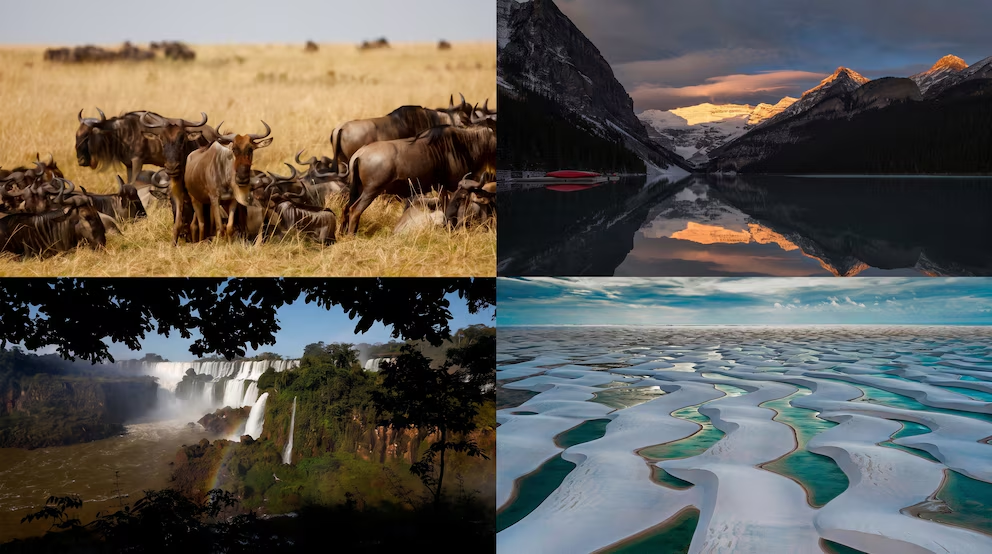
The most beautiful parks in the world:
1. Lençóis Maranhenses, Brazil
In the state of Maranhão, in northeastern Brazil, a field of white dunes extends over 155,000 hectares along the Atlantic coast. The Lençóis Maranhenses National Park is home to thousands of freshwater lagoons that form between January and June, during the rainy season.
A layer of waterproof rock located under the sand prevents rainwater from seeping, which generates natural pools that measure up to one hundred meters long and three meters deep. Although the landscape is reminiscent of a desert, the place receives about 1,200 millimeters of annual rain, well above the limit of 250 millimeters that defines an arid area according to international climatic parameters.
Between July and September, when the lagoons reach their peak, UNESCO, which declared the park a World Heritage Site in 2024, recommends the visit. The site also protects endangered species, including the scarlet ibis and the Antillean manatee.
2. Iguazu Falls, Argentina
On the river of the same name, 275 striking waterfalls unfold, which are sheltered in the Iguazú National Park, located in the Argentine province of Misiones. It shares a natural border with the Iguaçu National Park, on the Brazilian side, although about 80% of the waterfalls of the Iguazú Falls correspond to Argentine territory.
The central attraction of the system is the Devil’s Throat, a horseshoe-shaped fall where multiple waterfalls converge and rush 82 meters towards the canyon. The average flow rate at that point is around 1,500 cubic meters per second, although during floods it can exceed 12,000 cubic meters per second. Both parks have been part of the UNESCO World Heritage List since the mid-1980s and the Iguazú Falls were declared as one of the New 7 Wonders of Nature in the world, on November 11, 2011.
3. Cabo Pulmo, Mexico
At the eastern end of the Baja California Sur peninsula, Cabo Pulmo National Park protects one of the only three living coral reefs that remain in North America. Its formation is estimated at about 20,000 years, making it the oldest reef in the eastern Pacific.
Declared a protected marine area in 1995 after a request from the local fishing community itself, the park covers 71 square kilometers and is home to eleven species of hard coral along with more than 800 marine species.
Five of the seven endangered species of sea turtles in the world find refuge in their waters. The site has been part of the UNESCO World Heritage List since 2005.
4. Yellowstone, United States
Founded on March 1, 1872, Yellowstone was the world’s first national park. It extends for 8,983 square kilometers distributed mainly in Wyoming, with smaller portions in Montana and Idaho, on an active volcanic caldera considered one of the largest on the planet.
Under its surface are concentrated more than half of the active geysers that exist on Earth: about 500, within a total of 10,000 hydrothermal features that include hot springs, fumarolas and mud pools. The Old Faithful geyser erupts every 60 to 110 minutes and expels up to 8,400 gallons of boiling water.
The park also contains about 290 waterfalls. A fire that occurred in 1988 consumed about 36% of the total surface, an episode that changed US fire management policies in wild areas.
5. Banff National Park, Canada
In the province of Alberta, Banff National Park protects a portion of the Canadian Rocky Mountains, with glacial lakes exhibiting a turquoise hinge. Lake Louise, 2.4 kilometers long, remains accessible throughout the year, while nearby Lake Moraine, located in the Valley of the Ten Peaks, closes its vehicular access between October and the end of May due to the risk of avalanches.
Since 2023, Parks Canada banned the entry of private vehicles to the latter, which only allows transfers by public transport, bicycle or on foot. Both bodies of water feed on melting ice and maintain temperatures close to 3-4 °C throughout the year.
6. Namib-Naukluft National Park, Namibia
The oldest desert on the planet, between 55 and 80 million years old according to geological estimates, finds part of its protected territory within the Namib-Naukluft National Park, on the Atlantic coast of Namibia. With 49,768 square kilometers, it is one of the largest wildlife reserves in Africa.
Its dunes, of intense orange tone product of the oxidation of the iron present in the sand, are among the highest on the planet: some exceed 300 meters. The area known as Deadvlei is home to a plain of white clay surrounded by these formations, where the blackened trunks of camel thorn trees that died between 600 and 700 years ago, when changing dunes blocked the passage of the Tsauchab River to the place. The extreme dryness of the environment prevented the wood from decomposing.
7. Tsingy from Bemaraha, Madagascar
In western Madagascar, on the Bemaraha plateau, a karst landscape of limestone carved by water for millions of years unfolds. The Tsingy National Park of Bemaraha, together with the adjacent Integral Nature Reserve, protects a total of approximately 1,500 square kilometers formed on a Jurassic rock platform between 300 and 500 meters thick.
The Malagasy word “tsingy” translates roughly as “where you can’t walk barefoot,” in reference to the limestone needles that reach 100 meters in height. The site functions as a refuge for endemic species: it is home to at least eleven species of lemurs and a high percentage of reptiles that do not exist anywhere else in the world. Declared a World Heritage Site by UNESCO in 1990, access is limited to the dry season, between mid-April and mid-November, and requires the company of a local guide.
8. Serengeti, Tanzania
Established in 1951, Serengeti National Park covers 14,763 square kilometers of savannah in northern Tanzania. It is the scene of the Great Migration, the displacement of more than 1.5 million ñus accompanied by hundreds of thousands of Thomson zebras and gazelles, in a circular route of about 800 kilometers that is repeated every year.
The cycle begins between January and March, when half a million young are born in the southern plains in a period of just two or three weeks. With the arrival of the dry season, in May, the herds undertake the march to the north and must bypass the Grumeti and Mara rivers, where about 3,000 crocodiles are waiting. Every year thousands of wildebeests and zebras die from drowning, predation, exhaustion or illness during the journey. The Serengeti is also home to the largest population of lions in the entire African continent.
Infobae